
Nobody runs the Internet, and that was the point
Ask people who control the Internet and you usually get one of three answers: the Americans, the big tech companies, or "some UN body". All three are partly wrong, and the reason they are wrong says a lot about where the Internet is heading. In 2021 I defended a doctoral dissertation called Coordinating the Internet: Thought styles, technology and coordination. Over several years I talked to people who keep the Internet running day to day: the organisations behind country domains like .se, the operators of Internet exchange points where networks connect to each other, Internet service providers, engineers who write Internet standards, legislators and people who participate at UN-level forums. I also read the rulebooks and technical documents, and looked at the network itself. Here is what I found, and how it has held up.
The Internet has no boss, by design
The Internet is not one network. It is tens of thousands of independent networks, from small local area networks (LANs) and wide area networks (WANs) all the way to collections of Autonomous Systems (ASs)—networks with distinct routing policies—that have agreed to talk to each other using shared rules. Nobody forces network operators to do this. They do it because it works.
For that to happen, surprisingly little institutional overhead is required, even if sustaining this lightweight architecture demands continuous, rigorous technical coordination within the multistakeholder-model. In the dissertation I called it the Least Common Internet, and it has three parts:
- The rulebook: Shared technical standards, written mostly in an open forum called the IETF, where anyone can participate and proposals must be shown to work in practice before they become standards.
- The address book: Unique addresses and names, so that no two computers or websites are mixed up. This is the job of a function called IANA, today hosted by the organisation ICANN.
- The operators who actually run the cables, routers, switches, control planes, and servers, and who choose to follow the standards and reply on the unique addresses and names specified in.
That is it. Everything else, from websites to streaming to social media, runs on top of the Internet and is not the Internet itself. This separation was deliberate. The people who built the Internet wanted a network so simple and neutral that nobody could predict, or needed to approve, what it would be used for next. An important detail: the rulebook and the address book are both public and can be copied by anyone. If the organisations behind them ever went badly wrong, the rest of the world could in principle pick up the documents and carry on elsewhere. Several people I interviewed saw this as the Internet's real safeguard.
Three ways of seeing the same network
The most useful thing I found was not about technology. It was about how people think. When people argue about the Internet, they often talk past each other. I concluded that this is because they reason from three different sets of values, which I called thought styles:
- 1. The interoperability view (keep it open and changing). The most important thing is that everything can keep changing. Keep parts separate, keep coordination to a minimum, and don't lock anything in. This is how most of the Internet's original engineers thought.
- 2. The bureaucratic view (keep it under legitimate control). The most important thing is legitimate control: rules, oversight, accountability and the ability to sanction wrongdoing. This is how most regulators and governments think, whether democratic or not.
- 3. The market view (capture the value). The most important thing is capturing value. Standards and rules are good when they help your business and bad when they don't.
These are not job titles. I met engineers who thought like bureaucrats and civil servants who thought like the original Internet engineers. The striking pattern was that the bureaucratic and market views often end up on the same side, against the interoperability view. A large company and a regulator may both prefer a network where things are bundled together and controlled: one because control forces customers into a corner which generates better opportunities to generate profit, the other because it sees oversight as a necessary aspect of national governance.
Take net neutrality, the idea that Internet providers should treat all traffic equally. For the original engineers, a neutral network is simply what good design looks like. Regulators see it as something that needs a law. For companies it depends which side you're on: the telecom operator wants to charge more for some traffic, while large content providers like Netflix and Google want it all treated the same. Three groups, three completely different reasons, and often no shared ground to argue on.
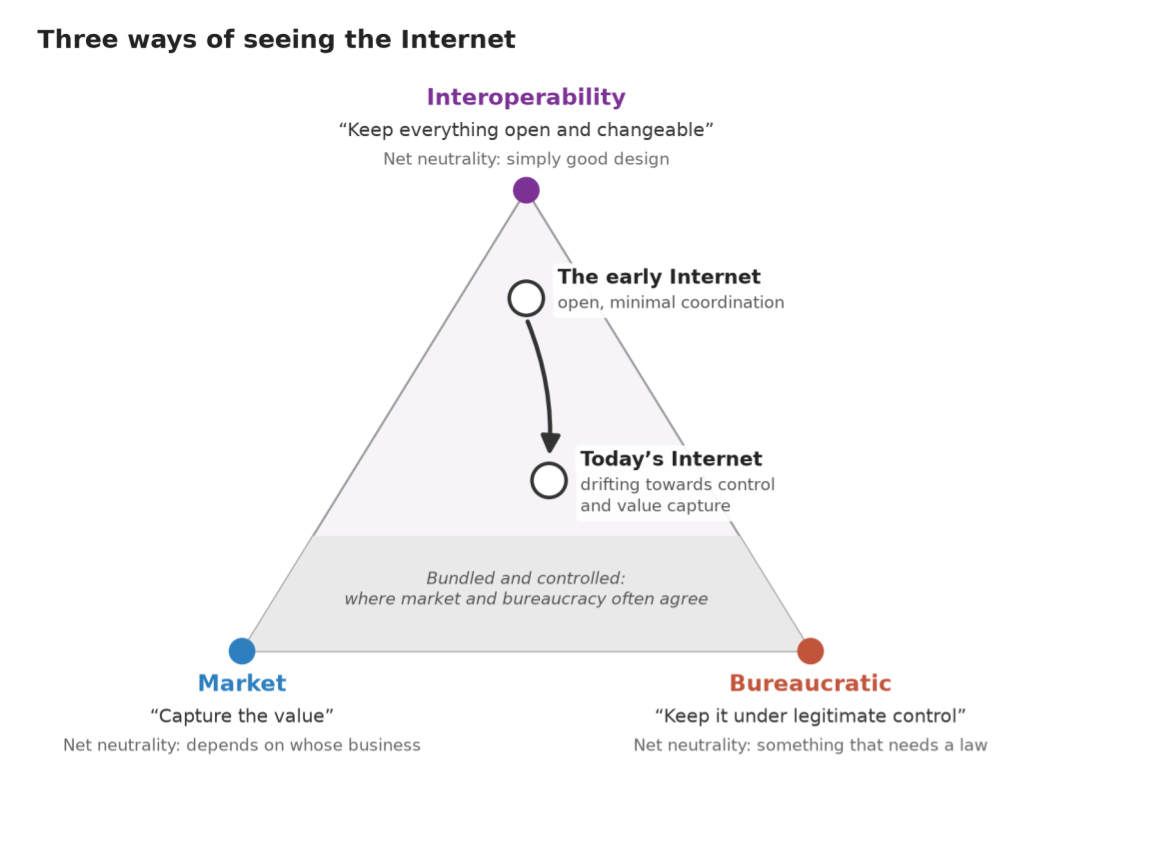
In my dissertation I use four different lenses: formulation of standards, implementation of standards, (actual) coordination, and meta-coordination. The figure above is an illustrative average of these dimensions. See the dissertation, linked at the end, for more nuance.
What I predicted
In 2021 I argued that the Internet was slowly moving away from its original design, pulled in two directions:
- Towards the market, as a few large companies increasingly shape the technical standards. A new transport protocol called QUIC, was one of my examples: it encrypts traffic in a way that makes the network more neutral, but also shifts power from the ISPs and similar operators to the largest online companies.
- Towards bureaucracy, as governments increasingly want to regulate the Internet's core functions directly, for example through the EU's then-upcoming NIS2 (Network and Information Security) cybersecurity directive, or through alternative architectural frameworks such as NewIP or IPv6+.
I also argued that multilateral intergovernmental forums like the ITU, which receive significant public attention, actually exercise limited direct authority over the day-to-day technical operational protocols of the Internet.
What has happened since
I recently looked at around 3,700 academic publications on internet governance from 2001 to 2025, and at what has happened in policy. I did so with the help of LLMs, as one does these days. Much of it has gone the way I expected.
Governments have moved in. "Digital sovereignty". has emerged as a central preoccupation in the literature. Rather than signaling endorsement, the surge in research utilising sovereignty frameworks—jumping from roughly 7% to nearly 19% over the last two decades—reflects how scholars are grappling with the regulatory pressures, fragmentation risks, and state-led interventions reshaping the network. Talk of geopolitics and a fragmenting Internet went from 2% to 11%. The EU's NIS2 directive now treats the companies that run domain names as "essential entities" regardless of size, with obligations on how they collect and share registration data.
Big companies have become bigger in “plumbing”. Researchers now study how the Internet is centralising around a handful of cloud and content companies, and how that concentration can itself be used as a tool of power. Even the engineers who write the standards have published guidance on how to avoid building standards that make centralisation worse. A 2025 study of how QUIC was standardised reaches conclusions close to mine about who gained from it.
Multilateral bodies remain largely consultative. Proposals to transfer core protocol administration to intergovernmental agencies failed to gain traction. While the UN Internet Governance Forum was permanently extended in December 2025, it serves as a critical multi-stakeholder dialogue space rather than an operational governance body—a role consistent with maintaining its open design.
What nobody picked up
There is one thing the research world has not taken up, the third view, or interoperability view, and I think it matters most.
Researchers now write a great deal about the tension between governments and companies, and between democracies and authoritarian states. They rarely name or touch upon the interoperability of it all: that the Internet's original design was itself a political choice, a deliberate decision to keep power spread out and the network open to whatever comes next. In the publications I looked at, that perspective shows up in less than one in fifty papers, and in the last five years in less than one in a hundred.
That matters because when the other two views agree — when a regulator and a large company both want more control, for different reasons — there is often nobody in the room arguing for keeping things open and simple.
Where I think I was too optimistic
Looking back, two things deserve more depth and nuance than I gave them.
First, the Internet's minimal core can stay perfectly intact while becoming less relevant. The rulebook and standards remain open and the address book remains shared, but most of what we actually do online now passes through a few very large companies sitting on top. The original design survives, yet the everyday experience centralises anyway.
Second, the "keep coordination minimal" view has a weak spot. Some problems are in everyone's interest to fix but nobody's individual interest to pay for. One classic example is BCP-38, a network approach to filtering that would block a whole class of cyberattacks. It has been known for more than twenty years and is still not universally used. Even one of the most interoperability-minded people I interviewed concluded that some regulation might be needed. The original Internet philosophy does not yet have a good answer to that.
Why this should matter to you
You don't need to understand routing tables to care about this. The question underneath is simple: should the network that carries almost all of our communication be treated like a utility run by governments, a product sold by companies, or shared infrastructure that nobody owns, like a language or a currency?
Each answer gives you a different Internet. For thirty years we have mostly had the third kind, without many people noticing. My advice from the dissertation still stands: don't take today's Internet for granted. Get involved in standards, support open infrastructure, and advocate for keeping the core open before decisions are made for you.
This commitment to an open architectural model is reflected in the work of operator-neutral Internet Exchange Points (IXPs) and independent DNS operators. By providing decentralised, non-discriminatory interconnection infrastructure, these entities safeguard the interoperability model against centralisation pressures, ensuring that operational sovereignty remains distributed across the network ecosystem.
This post draws upon the analytical framework presented in my doctoral dissertation, Coordinating the Internet: Thought styles, technology and coordination (Linköping University, 2021; available at https://doi.org/10.3384/diss.diva-173713), alongside a systematic review of subsequent internet governance literature.