
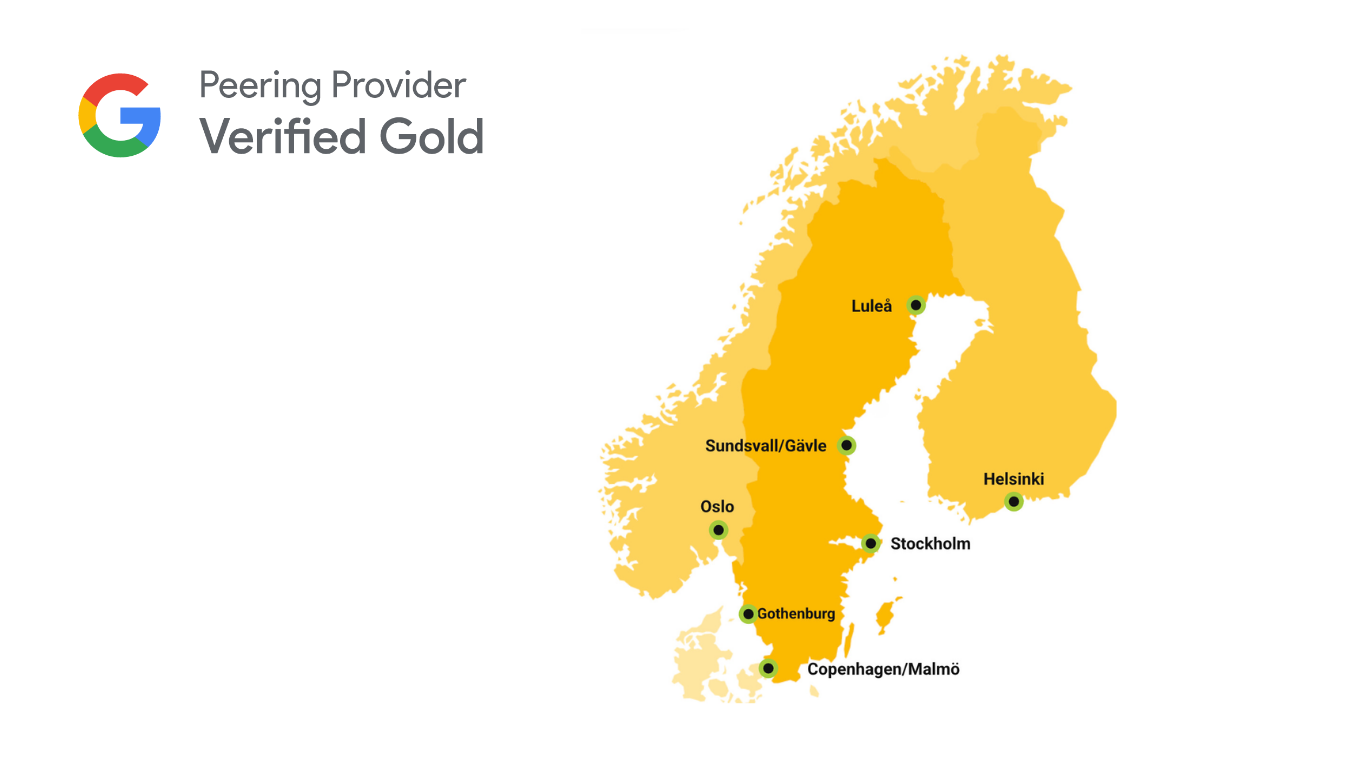
As part of the Google Verified Peering Provider (VPP) programme, Netnod provides access to Google's routes through the Netnod IX route servers at the Netnod IX Stockholm and the Netnod IX Helsinki.
From 18 November 2026, networks peering over the route servers at these Netnod IXes will receive Google's routes by default.
If you already peer with Netnod's route servers, no additional BGP session, peering agreement or fee is required.
How it works
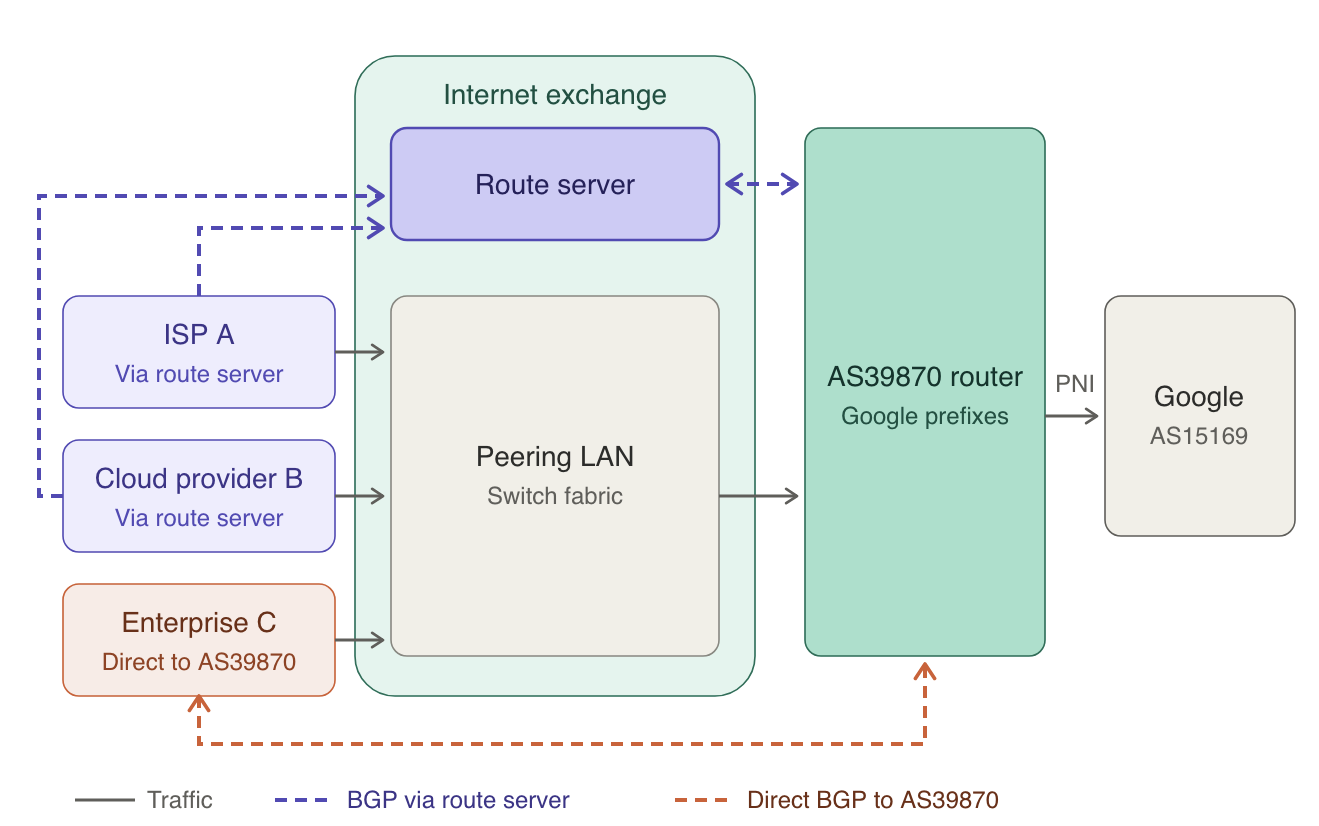
Netnod provides the service through AS39870 (NETNOD-SERVICES), which connects to Google and participates in Netnod's route server service as shown below:
| Netnod route server ASN | AS52005 |
| Netnod’s Google Verified Peering Provider service ASN | AS39870 |
| Example AS path | 39870 15169 |
| Default behaviour | Routes exchanged in both directions |
| Cost | No additional cost. Included in route server peering |
Google's routes are advertised through AS39870. Your router will see AS39870 ahead of Google's originating AS15169 in the AS path. The route server ASN (AS52005) is not added to the path.
Your routes are advertised towards Google through the same service, subject to Netnod's normal route-server filtering and export policies.
Do you need to change anything?
No. If you use Netnod's route servers at the Netnod IX Stockholm or the Netnod IX Helsinki, Google's routes will be available automatically through your existing BGP sessions.
However, we recommend reviewing your existing BGP policies, particularly if you already peer directly with Google.
- Route preference: Check that your local-preference settings produce the intended routing behaviour relative to transit and direct peering.
- AS-path filters: Ensure your filters accept Google's routes via AS39870 if you intend to use the service.
- Existing Google exclusions: Communities targeting AS15169 do not necessarily exclude the Google Verified Peering Provider service, which participates through AS39870.
- Maximum-prefix limits: Ensure your route-server sessions can accommodate the additional prefixes.
How to opt out
If you use Netnod's route servers at the Netnod IX Stockholm or the Netnod IX Helsinki and do not want to exchange routes with Google through Netnod's VPP service, we recommend opting out in both directions.
1. Prevent your routes from reaching Google
Add the following BGP community to routes you advertise to Netnod's route servers:
0:39870
This instructs the route servers not to advertise those routes to AS39870.
2. Prevent Google's Verified Peering Provider routes from reaching your network
Configure an inbound filter on your Netnod route server sessions to reject routes whose AS path begins with AS39870.
Note: You must apply both (1) and (2) above on every route server session at every VLAN where you are connected at Netnod IX Stockholm and Netnod IX Helsinki for both IPv4 and IPv6.
These changes do not affect your peering with other route server participants.
To opt back in, remove the export community and inbound filters.
For more information about supported BGP communities and route-server configuration, see the Netnod route-server documentation.
Frequently asked questions
1. Do I need a direct BGP session with Google?
No. Netnod manages the Google Verified Peering Provider connection. Your existing route server sessions are sufficient.
2. Does the service guarantee symmetric routing?
No. Exchanging routes in both directions helps support bidirectional connectivity, but actual traffic paths depend on routing policies in both networks.
3. Does opting out affect other route server peers?
No. The community and filter described above target the Google Verified Peering Provider service through AS39870.
4. We don’t peer at the route server but would like to connect to Google through Netnod. Is this possible?
Yes, you can set up a bilateral BGP session directly with Netnod’s Google VPP Service (AS39870) over your existing Netnod IX port. You don’t need to peer with the route servers to use this service. To request a session, contact peering@netnod.se.
How networks can peer with Google at the Netnod IX
